
Student Name
Capella University
NURS-FPX6200 Management and Leadership for Nurse Executives
Professor Name
Submission Date
Strategic Visioning with Stakeholders
Slide 1:
Hi, I am……., and today I will be sharing a proposed 5–10-year strategic plan for the expansion of telehealth and telemonitoring at our outpatient diabetes clinic.
Slide 2:
Diabetes mellitus is an increasing issue for adults in all countries and has emerged as one of the major causes of non-communicable diseases globally, with a rising and rapid trend of incidence and immense burden on primary health care services to deliver acceptable quality of care and treatment to all adults with diabetes in a successful manner. The outpatient diabetes clinic follows an integrated approach to the delivery of diabetes care with a focus on prevention, early detection, and sustained care for diabetes patients. The clinic is well utilized by a diverse population of patients, both economically and culturally, and regularly sees many patients who live in underserved and rural areas with significant barriers to care (Jacobs, 2021). This presentation outlines a 5-10 year strategic plan, which was developed from a SOAR analysis conducted by the outpatient clinic to ensure all key stakeholder groups have the necessary resources to enhance the implementation of telehealth remote patient monitoring to improve patient safety, quality outcomes, and organizational sustainability.
Figure 1
SOAR Analysis
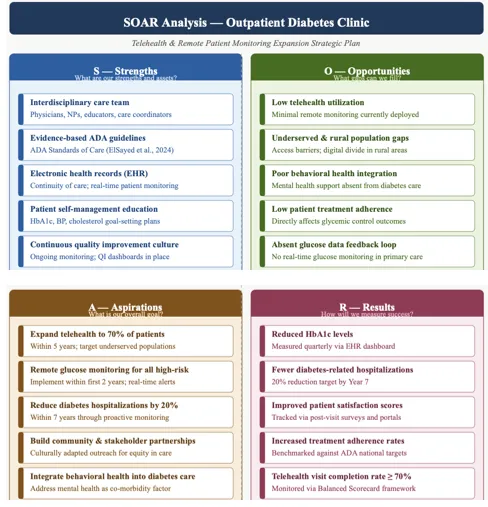
Strategic Goals and Implementation Metrics for Quality and Safety Enhancement
Slide 3:
There is a need to have strategic planning goals that have measurable patient safety and quality outcomes that are explicitly connected to the priorities of a healthcare organization. These goals will increase the use of telehealth for 70% of diabetic patients within 5 years, use of remote glucose monitoring for all high-risk diabetic patients within 2 years, and decrease hospitalizations due to diabetes by 20% in 7 years. Makhfudli et al. (2025) concluded that nurse-driven digitalized programs for diabetes will improve the self-care behaviors and hemoglobin A1c of type 2 diabetes patients living in a community setting. There are specific initiatives that help each of these goals, such as the implementation of a telehealth platform, the use of EHR-based glucose dashboards, the development of culturally-competent educational materials for the patient, and the development of community outreach organizations to effect sustainable improvements.
Weaknesses and Threats
Slide 4:
It is essential to clearly recognize both the weaknesses and associated risks for the current plan and to openly and honestly communicate these weaknesses in order to develop a plan to implement the long-term strategy. Some of the weaknesses identified include: limitations on the telehealth service delivery model due to insufficient technology infrastructure, lack of digital proficiency of staff, and insufficient access of patients living in rural areas to broadband internet. Okeke et al. (2025) identified two major challenges to the use of technology in community-based health care: lack of technology infrastructure and resistance of staff members to change. As long as these barriers are detected in the early stages, the leaders can design a successful overall plan with detailed risk mitigation strategies to prevent these barriers from affecting successful implementation.
Stakeholder Communication Strategy
Slide 5:
All key stakeholders must be trusted and committed to a strategic plan and a programme of regular communication with all stakeholders – via a series of town hall meetings, interprofessional team briefings, advisory patient roundtables, and quarterly dashboard reports to clinical and administrative leadership – must be put in place for a strategic plan to be effective. From the research of Rejas et al. (2022, stakeholders’ continued involvement and culturally relevant communication strategies have been cited as barriers to increasing patient engagement and interest in a telehealth program. Therefore, by utilizing a clear and defined method of conducting transparent and consistent communication, we will be able to ensure that all groups are kept informed, engaged, and aligned with the clinic’s evolving strategic plan for the entire duration of its implementation.
Assumptions
Slide 6:
The Strategic Planning sustainability framework’s assumptions are: the organization’s ability to enact the plan; the staff members’ willingness to use Charting; and the environment in which the organization operates. The assumption is that their administrative leadership will be stable and continue to support the clinic during the implementation phase of the plan (5-10 years), that they will have resources to develop the telehealth infrastructure, and that they will have adequate staffing levels. According to Rodriguez et al. (2022), continued institutional support of technology and workforce development is necessary for long-term continuous improvement in the quality of care provided to patients with diabetes. The unit’s key assumptions will be developed as contingency plans, and an annual strategic review will be conducted to address any contingency plans to ensure the overall resiliency and long-term sustainability of the strategic plan.
Strategic Alignment and Organizational Reconfiguration Plan
Slide 7:
To realize the clinic’s strategic goals, the clinic’s structure, system, shared values, management practices, staffing model, and professional competency must be systematically changed in a focused way to realize these goals. To meet these objectives, the following strategies will be implemented: Redesign patient care processes to integrate Telehealth into patient visits; Upgrade the EHR system to accept remote glucose monitoring data; Change roles to include a digital approach to patient care coordination; and align leadership values with equity and innovation. These results indicate that primary care organizations (PCOs) that aligned their organizational structure and leadership culture with the digital health priorities of the organization had a significantly higher rate of digital health technology adoption (Brommeyer et al., 2024). These actions will therefore ensure that all parts of the patient care environment continue to be enhanced to achieve the clinic’s safe and quality improvement aims.
Evaluation Criteria
Slide 8:
Properly training and orienting workers to their telehealth roles will facilitate the adoption of new models of telehealth care in a safe, uniform, and clinically trusted way. Success measures of the onboarding process can be measured by employee competency scores, completion rates of telehealth training modules, time until the employee becomes proficient, and employee satisfaction with their training within the first 90 days after starting their position (survey response). The findings of Ong et al. (2025) show that a structured approach to onboarding employees into an electronic clinical system would significantly minimize error and boost employees’ confidence in the use of technology for patient care. To do this, leaders will be able to assess training needs early on in the onboarding process and enhance training to address future needs of the program as it continues to evolve.
Strategic Implementation and Outcome Evaluation Framework
Slide 9:
There needs to be a systematic method to assess the effectiveness of this plan to be able to compare the results of the implemented plan to the pre-planned clinical/operational practice. This includes a drop in HbA1c and a reduction in diabetes related hospitalizations, communication between patients and the patient portal, and the success rate of telehealth visits, as well as patient satisfaction on the EHR dashboards and quarterly quality improvement reports. The metrics will be used to determine a balanced scorecard with four areas/perspectives (Financial, Patient experience, Internal process, Staff learning and growth) to be used for consistent evaluation (Amer et al, 2022). In addition, these metrics will be compared to national benchmarks (established by the American Diabetes Association Standards of Care) and diabetes goals established by the Healthy People 2030 national agenda to provide evidence of improved diabetes outcomes during the implementation period.
Uncertainty and Gaps
Slide 10:
There is abundant evidence for the use of telehealth to treat diabetes. There are still significant challenges and questions to be addressed regarding the implementation of telehealth via the telephone with diabetes patients, though, which could affect some patients’ ability to fully participate in the intervention. There is limited data available on the effectiveness of remote glucose monitoring over time in older adults, low-literacy individuals, and in rural settings, for Example. In addition, Litchfield et al. (2023) cited the need for more ways to engage individuals of varying backgrounds as a means to increase the number of individuals participating in the implementation of the telehealth program. If these gaps are identified and addressed through continued evaluation of upcoming telehealth programs and continuous learning cycles, the evidence supporting the clinician’s telehealth intervention will increase dramatically over time as clinicians and their patients can expand on what worked and didn’t work for the telehealth program.
Cultural, Ethical, and Regulatory Framework for Strategic Implementation
Slide 11:
The design and implementation of the Strategic Plan relied on the Cultural and Regulatory Principles to provide guidance on all aspects of the Strategic Plan. The ethical principles used to ensure that patients gave informed consent, established the clinical and safety evidence base for the use of technologies, ensured that patients had equal and equitable access to the technology, and prevented any potential harm from the use of remote monitoring technologies were ethical principles. Lechner et al. (2024) see Cultural Humility and Cultural Safety as being fundamental elements of good, inclusive, and respectful healthcare. Adherence to the Health Insurance Portability and Accountability Act (HIPAA), American Disabilities Act (ADA), and the Centers for Medicare and Medicaid Services (CMS) telehealth reimbursement policies is woven throughout the entire plan to ensure legal, ethical, and professional accountability as the fully forward strategic plan is implemented in each stage of the process.
Potential Conflicts
Slide 12:
Adopting telehealth in a wide variety of clinical settings can present ethical issues and new regulations that must be handled professionally. One potential challenge is that resources allocated to provide access to digital services for disadvantaged populations may conflict with existing service delivery models, which have their own allocation of resources. Another consideration in the implementation of a telehealth service is the impact of the need for HIPAA compliance on the ability to provide communication using culturally preferred methods due to potential decreased flexibility of those methods. Leaders need to play an active role in advocating for needed changes to policy, as there is a misalignment between policy and the cultural safety of minority and Indigenous patients, as noted by Kaphle et al. (2021). Leaders will need to proactively identify and resolve potential conflicts, which will require a policy review process with consultation of impacted communities, along with interdisciplinary dialogue about the ethical ramifications of the implementation of telehealth services, to continue building trust and ensuring integrity throughout the implementation process.
Leadership Role and Theoretical Framework
Slide 13:
In any clinic setting where multiple disciplines share space, there will always be a nurse leader who takes on the role of the primary team member with a variety of different responsibilities related to the design and implementation of a telehealth strategic plan and continual evaluation and refinement of the plan. This person should have the leadership abilities needed to engender a shared vision for the use of technology in diabetes care; inspire, motivate, and energize all members of the healthcare team in their collective efforts to develop creative solutions utilizing technology; and demonstrate the values of the profession that form the foundation of the overall strategic plan for the use of telehealth in diabetes care. In addition, Hashish et al. (2025) indicate that transformational and digital (technologically savvy) leadership skills will help support the long-term sustainability of integrated technology into primary care nursing. Further, servant leadership and change management leadership models offer the nurse leader tools to overcome the barriers that might enable him or her to successfully implement a telehealth service by empowering frontline staff to find new ways to provide care to patients and providing a structure to help guide the clinic through the required cultural changes to support the successful implementation of the telehealth service over time.
Assumptions
Slide 14:
The assumptions concerning the nurse leader’s position pertain to: the individual’s ability; the organization’s support; and the social/working environment of the professional practice environment. The nurse leader should be digitally health literate, knowledgeable in change management, be able to communicate effectively across disciplines, and lead in a culturally competent manner. Further, it is expected that the culture of the institution will be conducive to the innovation of the profession of nursing and that its administrative leadership will constantly provide support for the development of the nurse leaders and their implementation of strategic decisions throughout the implementation of the strategic plan (Makhfudli et al., 2025). The above assumptions should be evaluated periodically to ensure their continued validity, support, and effectiveness in relation to emerging trends in nurses’ capacity to operate as nurse leaders.
Leadership Qualities and Skills Critical for Strategic Success
Slide 15:
The specific characteristics and professionalism of the nurse leader are very much directly connected or interrelated with the nurse leader’s successful facilitation of this strategic initiative of telehealth. Visionary thinking, emotional intelligence, cultural competence, proficiency with data, and collaborative communication are all of equal importance and value in addressing the myriad of complex human, clinical, and technological aspects of a successful decade-long implementation process. In confirmation, Ismail et al. (2025) concluded that nurse leaders who have a combination of competent skills in the utilization of digital technologies and have excellent interpersonal and organizational skills are far more successful in their leadership of sustainable health technology initiatives. These qualities of the nurse leader will not only assist them in successfully implementing a strategic plan but will also enable the nurse leader to continually develop, enhance, and advocate for the strategic plan as new challenges and opportunities arise.
Personal Leadership Development
Slide 16:
Nurse leaders who are effective in their roles accept that they also have their own areas of need for continued development as part of their commitment to continual growth and success in the role of strategic leadership. Opportunities for personal growth identified in this plan involve gaining further knowledge and enhancement of health informatics knowledge; expanding grant writing skills and funding sources for telehealth programs; and enhancing cultural competence skills with the most underserved members of the clinic’s patient population. Leaders who are continuously developing their digital and cultural competencies are more likely to continue to innovate and drive change in their organisations in a complex healthcare setting, as stated by Tsekouropoulos et al. (2025). When these growth opportunities are incorporated into an individual nurse leader’s leadership style and behavior, it will provide the nurse leader with greater ability to provide examples of lifelong learning to the rest of the interdisciplinary care team and foster an environment that encourages professional development through the entire team.
Conclusion
Slide 17:
This strategic plan will develop a comprehensive, long-term, evidence-based, ethical strategy to launch the Outpatient Diabetes clinic with telehealth and remote patient monitoring in the next 10 years. The leadership of the outpatient diabetes clinic has formulated three strategic goals that are clearly defined with measurable benchmarks, supporting literature (including leadership theory), cultural competence, and regulatory compliance. Through these objectives, the outpatient diabetes clinic will promote ongoing patient safety and quality improvement and incorporate culturally appropriate diabetes-specific telehealth systems for each of its many, diverse, and underserved patient populations. Further, the outpatient diabetes clinic will facilitate transformational and sustainable changes in the quality of diabetes care available to its patients and communities through the culture of continual inquiry, effective communications to stakeholders, and the development of adaptive leadership styles.
References
Amer, F., Hammoud, S., Khatatbeh, H., Lohner, S., Boncz, I., & Endrei, D. (2022). The deployment of balanced scorecard in health care organizations: Is it beneficial? A systematic review. BioMed Central Health Services Research, 22(1), 1–14. https://doi.org/10.1186/s12913-021-07452-7
Brommeyer, M., Whittaker, M., & Liang, Z. (2024). Organizational factors driving the realization of digital health transformation benefits from health service managers: A qualitative study. Journal of Healthcare Leadership, 16, 455–472. https://doi.org/10.2147/jhl.s487589
Hashish, E. A., Alsayed, S., Alqarni, B. H. M., Alammari, N. M., & Alsulami, R. O. (2025). Nurse managers’ perspectives on digital transformation and informatics competencies in E‐leadership: A qualitative study. Journal of Nursing Management, 2025(1). https://doi.org/10.1155/jonm/8178924
Ismail, H. A., Kotp, M. H., Ahmed, H., Eldin, E., Sayed, S., Mohammed, S., Ahmeda, A., Hendy, A., & Aly, M. A. (2025). Sustainable healthcare futures: how digital leadership stimulates nurses’ green creativity: A quasi-experimental study. BioMed Central Nursing, 24(1). https://doi.org/10.1186/s12912-025-02906-3
Jacobs, J., Dougherty, A., McCarn, B., Saiyed, N. S., Ignoffo, S., Wagener, C., Miguel, C. S., & Martinez, L. (2024). Impact of a multi-disciplinary team-based care model for patients living with diabetes on health outcomes: A mixed-methods study. BioMed Central Health Services Research, 24(1). https://doi.org/10.1186/s12913-024-11062-4
Kaphle, S., Hungerford, C., Blanchard, D., Doyle, K., Ryan, C., & Cleary, M. (2021). Cultural safety or cultural competence: How can we address inequities in culturally diverse groups? Issues in Mental Health Nursing, 43(7), 1–5. https://doi.org/10.1080/01612840.2021.1998849
Lechner, B. E., Kukora, S. K., & Hawes, K. (2024). Equity, inclusion, and cultural humility: Contemporizing the neonatal intensive care unit family-centered care model. Journal of Perinatology. https://doi.org/10.1038/s41372-024-01949-9
Litchfield, I., Barrett, T., Shield, J. H., Moore, T. H., Narendran, P., Redwood, S., Searle, A., Uday, S., Wheeler, J., & Greenfield, S. (2023). Current evidence for designing self-management support for underserved populations: An integrative review using the example of diabetes. International Journal for Equity in Health, 22(1). https://doi.org/10.1186/s12939-023-01976-6
Makhfudli, M., Efendi, F., Pradipta, R. O., Ismanto, A. Y., Chong, M.-C., & Tonapa, S. I. (2025). Efficacy of nurse-led digitalized diabetes management program for community-dwelling patients with type 2 diabetes mellitus: A systematic review and meta-analysis. Journal of Nursing Scholarship: An Official Publication of Sigma Theta Tau International Honor Society of Nursing. https://doi.org/10.1111/jnu.70022
Okeke, E. B., Forman, D., Taylor, E., Hyde, E., Parente, F., Kanmodi, K. K., & Wordsworth, S. (2025). Barriers and facilitators to digital health adoption: A thematic analysis of healthcare professionals’ perspectives in rural Oyo State, Nigeria. BioMed Central Digital Health, 3(1). https://doi.org/10.1186/s44247-025-00227-8
Ong, K. P., Chen, E., Oh, E., Lee, E. S., Tang, W. E., Ng, D. W. L., & Teo, V. (2025). Understanding the patients’ experience in primary technology-enhanced care home HbA1c testing (PTEC HAT) programme—A qualitative study. BioMed Central Primary Care, 26(1). https://doi.org/10.1186/s12875-025-03034-2
Rejas, V. M. G., Thomas, E. E., Kelly, J. T., & Smith, A. C. (2022). A multi-stakeholder approach is needed to reduce the digital divide and encourage equitable access to telehealth. Journal of Telemedicine and Telecare, 29(1), e211079. https://doi.org/10.1177/1357633×221107995
Rodriguez, K., Ryan, D., Dickinson, J. K., & Phan, V. (2022). Improving quality outcomes: The value of diabetes care and education specialists. Clinical Diabetes, 40(3), 356–365. https://doi.org/10.2337/cd21-0089
Tsekouropoulos, G., Vasileiou, A., Hoxha, G., Theocharis, D., Theodoridou, E., & Grigoriadis, T. (2025). Leadership 4.0: Navigating the challenges of the digital transformation in healthcare and beyond. Administrative Sciences, 15(6), e194. https://doi.org/10.3390/admsci15060194